An Honest Commentary on the Programme
Cross Cutting Reflection · MSc Computer Science (Conversion) · Author: Orville Fernandes
The Verdict
If a friend asked me whether this programme was worth doing, I would tell them to save their money. That is the honest answer, and I think it is worth saying plainly rather than burying it in qualifications. I came into this MSc with a BSc Psychology with a minor Applied Computing and some professional experience in technology. I did not learn anything meaningfully new from the taught content. That is not a small thing to say about a postgraduate degree.
The Conversion Course Problem
The MSc Computer Science (Conversion) is, as the name suggests, designed for students coming from non-CS backgrounds. That is a legitimate and useful thing to offer. The problem is that the programme does not appear to differentiate between students who need that conversion and students who do not – and it does not make the level of the content clear during admissions. The programme's own website describes it as being for people "looking to pivot into computer science" from a different field. What it does not say is that the content is pitched at a genuinely introductory level – or that applicants with prior CS knowledge or industry experience should expect to cover ground they have already covered. The marketing language suggests depth and industry relevance. The reality, in my experience, did not match that.
If that had been communicated clearly upfront, I could have made an informed decision. Instead, I discovered it module by module, as content I had covered in my BSc – or encountered in professional practice – was presented as new and advanced. Some of it did not even meet the standard I would expect of undergraduate teaching. The word "Masters" should mean something, and for a conversion course it needs to mean something specific, clearly stated, and honestly marketed.
What Were We Actually Promised?
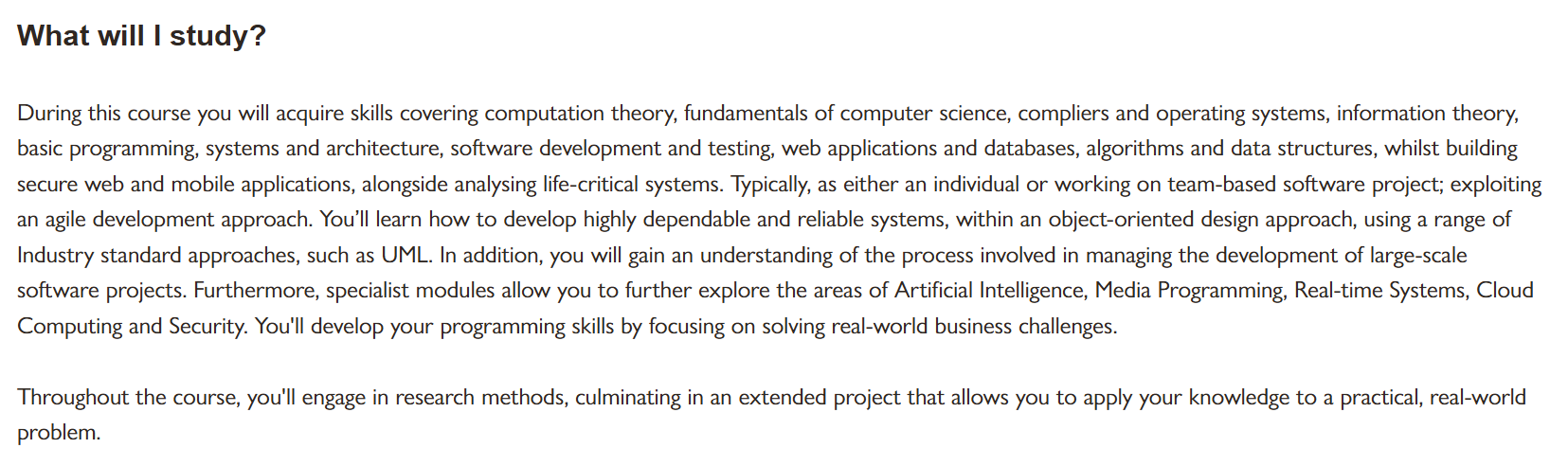
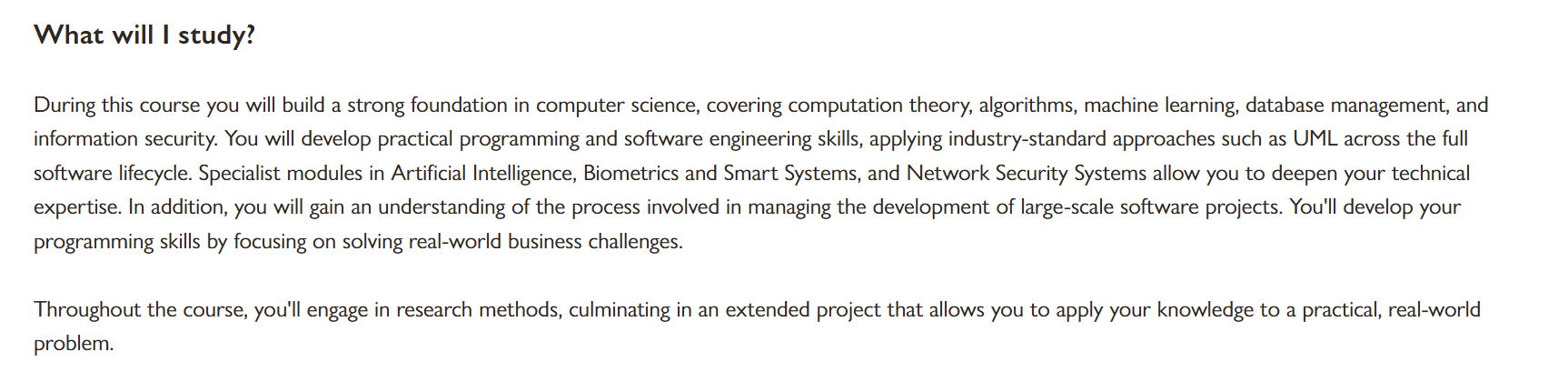
The course page that greeted prospective students – and that remained live several months into the programme, as late as April 2026 – described something that sounds, on paper, like an impressively comprehensive degree (BNU, 2026). Skills covering computation theory, compilers and operating systems, information theory, systems and architecture, algorithms and data structures. The opportunity to build secure web and mobile applications. An agile development approach. Specialist modules in Artificial Intelligence, Media Programming, Real-time Systems, Cloud Computing and Security.
It is worth reading that twice, because the gap between that description and the programme that was actually delivered is substantial.
Of the three specialist areas listed alongside AI and Security – Media Programming, Real-time Systems, and Cloud Computing – not one was offered. No module, no lecture series, not even a guest session. These were not fringe interests buried in the small print; they were named prominently as the advanced, specialist component of the degree. Cloud Computing in particular is not an obscure niche. It is arguably the defining infrastructure shift of the last decade, and it was listed as a reason to enrol. When a student raised this discrepancy, the response was to update the website.
The language throughout the old description is worth examining on its own terms. "Whilst building secure web and mobile applications" – the programme included one web application project and 2 modules had elements of security, running separately with no meaningful integration. Mobile applications did not feature at all, other than a passing mention of responsive design for websites. "Exploiting an agile development approach" is another interesting claim. Agile was mentioned in Computer Science Overview, and discussed briefly in Software QA and Engineering, with no practical demonstration and no coursework designed around it. Agile is a team-based iterative methodology; it requires a project to apply it to. By the time agile was discussed into some level of detail (brief as it was), the practical work was already done.
The description reads like it was written to impress rather than to inform. For a postgraduate programme attracting students who are making a significant financial and professional commitment, it set expectations that the course was not designed to meet.
Depth, and the Kid Gloves Problem
Across almost every module, detail was deferred. "We will not go into that here, but further reading is available." That phrase, or something like it, became a recurring feature of the year. I understand that breadth and depth are always in tension in a taught programme. There is a version of that tension that feels like a considered teaching choice, and there is a version that feels like students are being treated as though the advanced material would be too much for them. Too often, the programme felt like the latter.
A Masters-level student should be expected to engage with complexity, ambiguity, and technical depth. Scaffolding is fine. Permanent simplification is not. When difficult concepts are consistently waved away toward optional reading, students who would have engaged with them never get the chance to, and students who needed them to be taught never actually learn them.
Theory Without Practice
The balance between theory and practical application was the most consistent weakness across the programme. Most modules were heavily lecture-led, with practicals that either did not exist, were too shallow to build real skill, or were not connected closely enough to the assessed coursework. This is not just an engagement problem, but a relevance problem. I do not feel that the taught content of this programme has prepared me for a job in a meaningful way. The things I have developed and built on this programme owe very little to what I learnt on this programme, and honestly more to my independent learning, my professional background and my BSc.
Coursework assignments compounded this. Several of them felt misaligned with their modules. A well-designed coursework should require the application of something the student was not previously exposed to, ideally something industry-relevant or with significant technical depth, and it should offer a clear path for students who want to go further. At least half if not more of the courseworks on this programme did neither.
What I Would Change
I have thought about this enough to have specific suggestions. The introductory module covers a lot of ground, but much of it is surface-level. I would compress that content to half the module and use the other half to introduce students to coding – giving everyone a foundational practical skill from week one that they can build on throughout the year. That single change would do more for student confidence and capability than any amount of additional lecture content.
More broadly: coursework briefs should require demonstrable engagement with new skills or technologies, not just the application of concepts covered in class. Marking criteria should reward students who go beyond what was taught, but also provide an accessible path for getting there – not leave exploration as an optional extra. And the practical component of every module should be given the same weight and attention as the theoretical content, not treated as a supplementary activity.
A Note on Artificial Intelligence
BNU's guidance on AI is measured – it permits generative tools for brainstorming, drafting outlines, and refining your own writing, while prohibiting their use to generate assessed content directly (Buckinghamshire New University, 2025). The intent is reasonable. The execution, however, addresses a symptom rather than the cause.
The practical problem with drawing lines around prompts is that it is largely unenforceable, and it directs energy towards policing behaviour rather than improving what is being assessed. If a student can submit a high-grade piece of work generated almost entirely by AI, the issue is not that AI exists, it is that the task is not adequate. Better task design is the remedy, not tighter declarations.
This mirrors a pattern that recurs every time a significant technology arrives. Calculators were banned from school mathematics; they are now standard. The internet was treated with suspicion in classrooms; it is now the primary research tool (Cuban, 2001). In each case, the initial instinct was resistance, followed (eventually) by adaptation. AI is the current chapter of that same story. The World Economic Forum (2025) identifies AI and machine learning literacy as among the fastest-growing skills in employer demand; a programme at Masters level would arguably serve its students better by treating AI fluency as a skill to develop, not a temptation to suppress.
There is also a practical reality worth stating plainly: if a student submits work that shows no real engagement, no individual voice, no evidence of the kind of thinking that a year of study should produce, surely it would be obvious. The current approach creates administrative overhead around a problem that thoughtfully designed assessments would largely solve on their own.
The Exception
I want to be fair. There was one consistent bright spot across the programme, and that was the module leader responsible for both Database Design and Software QA and Engineering. The content in both modules was not particularly more substantive by the standards of the programme. More than the content, it was the approach: enthusiastic, practically grounded, and openly invested in students doing well. I did not come away from those modules having learnt a huge amount of new content – the fundamentals of database design were not new to me – but I came away having learnt a great deal about professional practice, how to think about quality, and what it looks like when someone really cares about the content they are teaching and holds it to a certain standard. That combination is rarer than it should be, and it stood out.
A Final Note
None of this is written to be cruel to the people who designed or teach this programme. Almost all of them are excellent. All of the regular lecturers know you by name and are very approachable and very willing to help. They are all clearly well versed in their respective fields. However, there was a recurring theme that some lecturers were delivering modules outside their primary specialism, which they acknowledged. Even so they were always willing to go over material and work through ambiguities with you.
A critical reflection that glosses over a year of disappointment would not be honest, and honesty is the point of this portfolio. The programme gave me a qualification and some structure. It did not give me the level of intellectual challenge or the practical depth I came for. I think prospective students deserve to know that, and I think the programme would benefit from hearing it.
References
Buckinghamshire New University (BNU) (2025) Artificial Intelligence guidance for students. Available at: https://www.bucks.ac.uk/current-students/registry-helpdesk-and-academic-advice/artificial-intelligence-guidance-students (Accessed: 18 June 2026).
Buckinghamshire New University (BNU) (2026) MSc Computer Science (Conversion). Available at: https://www.bucks.ac.uk/courses/postgraduate/msc-computer-science-conversion (Accessed: 18 June 2026).
Cuban, L. (2001) Oversold and Underused: Computers in the Classroom. Cambridge, MA: Harvard University Press.
World Economic Forum (2025) The Future of Jobs Report 2025. Geneva: World Economic Forum.

Comments Authorised users only
Welcome to the portfolio. If you've got the password, (you know who you are) leave a note.